Thinking of applying for a grant?
Applying to one of our funding programmes? This page has everything you need to get started.
Take a look at our open programmes to find the right funding opportunity, use the eligibility checker to see if you qualify, then use the links below for step-by-step help with your application.


How to apply
You must apply using our online applications portal (external link). If you don’t have an account, you’ll need to create one. If you’re awarded a grant, you’ll need this later down the line as well – so save your login details somewhere safe.
The application form for each programme is on the programme’s page. Questions may vary by programme.
Some programmes require you to upload supporting documents – the guidance will tell you about this. Don’t send additional information after you submit your application, unless we ask for it.
Eligibility
Our standard eligibility guidance applies to all applicants.
Please note: you must also read the programme guidance for the specific programme you wish to apply to before beginning your application. There may be additional eligibility criteria you’ll need to meet, beyond our standard eligibility.
You can also use our eligibility checker to see if you meet the criteria.

Making a great application
We’ve put together resources to help you submit the strongest application possible. Our videos and infographics cover common mistakes to avoid, how to complete the form, and guidance on budgets, ethics and sustainability.
You might also find it useful to look at information on projects we’ve already funded.
Watch our video for a step-by-step walk though the application process.
Before starting your application, please ensure you have read the guidance and FAQs for the programme you wish to apply for. You’ll find these on the programme webpage. This will help ensure your project is a good fit and meets the programme’s aims and outcomes.
Watch our video to find out about some of the common mistakes applicants make when applying to our programmes.
What is a project?
A project is a piece of work with a clear purpose and evidence of need. It should include planned activities over a set time period, with a defined budget, to deliver specific changes.
By ‘project’, we don’t mean a one-off activity (for example, a single family fun day). A project is additional to business-as-usual: the routine work you already do year-round.
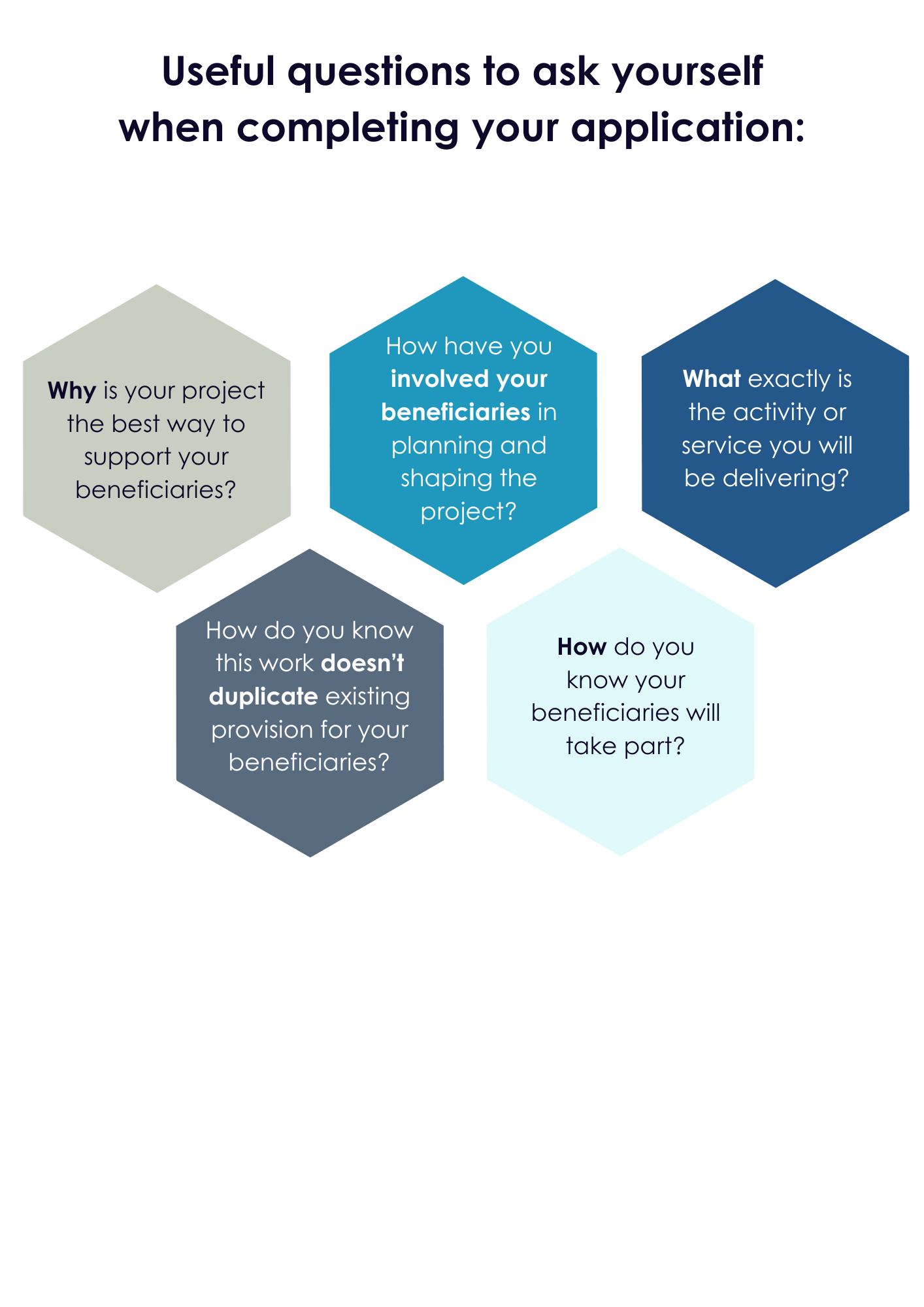
Your application must tell us:
- The problem you are trying to solve
- What difference your project will make
- How funding will be spent to deliver your project
Useful infographics
Click each image to download the infographic.


Using Artificial Intelligence (AI)
You can use AI to help start your answers. Please check and improve anything AI writes. We may reject applications if we have concerns about accuracy. If you use AI, please tick the box on the application form to tell us—this helps us improve our support.
Your application must reflect your real work and the real needs of the people you support. AI should never be used to invent experiences, quotes or needs, or to produce answers that don’t genuinely reflect what is happening in your project.
We are looking for honest, thoughtful responses written in your own voice. The strongest applications show that you know the people you support and can clearly explain the difference your project will make.
If you use AI to help you draft, check that your answers are accurate, personal and true to your experience.


Sustainability
We want to fund projects with lasting benefits. This means that we are interested in
what will happen in the long term, after your funded project has ended. The application form will include sustainability questions tailored to each grant programme.
Ethics
We need to know you have the skills and experience to work with your target groups, keep them safe, and take an ethical approach.
We will ask you to confirm in your application form that you will deliver your project in line with our code of ethical conduct.
We expect all funded organisations to exercise ethical principles of governance and delivery in line with Section 4 of the Charity Code of Governance (external link).
Our Ethics Advisory Panel, made up of Trustees and independent experts, provides guidance to us on ethical issues.

Subsidy Control Act 2022
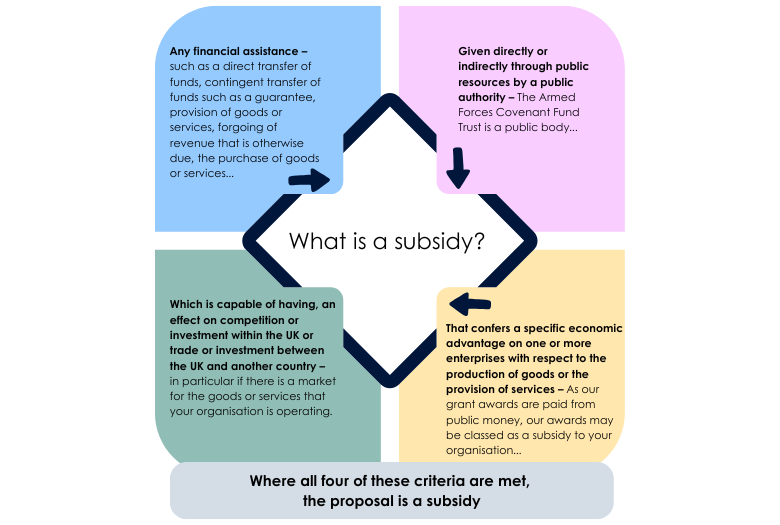
The Armed Forces Covenant Fund Trust is a public body. We are required to follow specific rules under the Subsidy Control Act 2022. This law requires us to be transparent about how we use public funds, which we provide as grants.
The Subsidy Control Act is important for anyone thinking about applying for our grants. We encourage you to understand its requirements, which are outlined in the guidance from the Department of Business and Trade (opens a PDF file). This guidance helps organisations like ours distribute funds responsibly, making sure they are used effectively and fairly, without negatively impacting competition or investment.
Definition of capital costs
When you set your budget, check how your costs fit within each programme’s maximum amounts for capital and non-capital funding. Programmes may fund non-capital costs, capital costs, or both. Any costs we support must relate to a defined project - we cannot fund ongoing revenue (sometimes called ‘core’) costs.
After you submit your application
You’ll get an automated email from noreply@yourcause.com to confirm submission (it’s a no-reply address; consider adding it to your safe senders). If you don’t get this email, your application wasn’t submitted – please log back in and submit.
We will review your application against the criteria and may contact you to clarify details.
You will receive a decision by the date on the programme page.
Please note
If your application is handled by one of our external grant assessors, they may contact you from a non-Trust email address. Be assured that our external assessors will always clearly identify their role and copy the Trust Grants Manager for the programme into their email.
If you have concerns after receiving an email from a non-Trust email address, you can contact us at info@covenantfund.org.uk.
Checks we may carry out on your organisation
We will carry out several checks on the information you provide and about your organisation.
This might include checks:
- on whether financial information on your application form matches that held by your regulatory body (Companies House, Charity Commission etc.)
- that we can see that you have a minimum of three unrelated Directors or Trustees listed on your regulator’s website. Please note, we do not class company secretaries as Directors of CICs, unless they are registered separately as a Director as well.Please note, we do not class company secretaries as Directors of CICs, unless they are registered separately as a Director as well.
- that your governing documents (such as constitutions and memorandum and articles of association) are up to date, correct and properly signed
- on your accounts that are accessible through regulatory bodies
- on any identified concerns about a person named as a contact or who has a position within your organisation
- that the signatories are valid and well informed about the project on your annual report and on your website/social media activity and other publicly available information, to ensure that your organisation is undertaking the activities as described in your application
- to ensure you are up to date on all reporting with any active grants you hold with the Trust
- if your organisation is a branch of a larger organisation (such as charities with regional branches or offices), as part of our due diligence checks we may be sharing key details of the application with your head office to confirm eligibility to apply for this funding. We may also require the second contact from your organisation to be from head office depending on your structure
- if you are awarded a grant, that your organisational name and address on your bank statement are consistent with the details you’ve provided in any completed form or the information that is held elsewhere in the public domain. We’ll need you to explain any inconsistencies
- if you are awarded a grant, that your bank statement shows that your account is being managed in line with your own financial procedures and our programme requirements

How we make decisions on your application
Our Board of Trustees or Grants Committee will make the final decision. They will assess applications against the criteria in the programme guidance. Funding is limited, so they will use their judgement to choose which projects to fund and to ensure a good mix of supported projects. Sometimes we have to turn down strong applications but we will always give you feedback to explain why.
If you’ve had a grant from us before, we expect your reporting to be up-to-date. We may take this into account when assessing new applications.
We may decide to part-fund your proposal. This means you may be offered less than you applied for. If this happens, we’ll talk through what we can and cannot fund, and why. You can then choose whether to accept the offer.
Please note: to reduce the risk to public funds, we may prioritise applicants who have a strong reporting track record with regulators (such as the relevant charity commission), clear and effective governance, and published accounts that are complete and up to date.
What happens if we award you a grant?
We’ll email you to let you know if you’ve been successful and what you’ll need to do next. See our what happens when we award you a grant infographic (opens an image file) for full details.

Good to know
If you receive a grant, you’ll need to keep clear records of how you spend the money and who you support (and how). Under the funding terms and conditions, you’ll need to update us on your project’s progress, including how you’ve spent the funding. We may also ask you to take part in evaluations, impact studies, or other research linked to your funding. We’ll tell you what’s required and how to take part.