West Mercia Women’s Aid – The Penelope Project
West Mercia Women’s Aid received a grant through the Free from Fear programme to support their project, The Penelope Project- an initiative designed to work with the military service to help domestic abuse victims access confidential, independent advice and support, enabling them and their children to move towards safety and recovery.
Research from the King’s Centre for Military Health Research (KCMHR) at King’s College London revealed that armed forces personnel are significantly more likely to both experience and perpetrate intimate partner violence and abuse (IPVA) than the wider civilian population (More than 1 in 10 Armed Forces personnel have experienced Intimate Partner Violence and Abuse | King’s College London)
In this context, the project aims to establish long-term, sustainable improvements to the way support is delivered, ensuring services can adapt to the evolving needs of victim-survivors.
For those living within the armed forces community, the unique pressures of military life can make an already hidden crime even harder to identify and address. Few practitioners have a deep understanding of both the military environment and the complex dynamics of domestic abuse. Meanwhile, the naturally private culture within the forces often restricts the access that local independent specialist services need to provide effective support.
Collaborative approaches to support
Working in partnership with the Garrison at Credenhill and Clive Barracks in Shropshire, the Penelope project has already transformed the local response to domestic abuse. An immediate and steady flow of referrals has emerged – victims who may otherwise have remained unseen. The project has broadened its reach to support not only military spouses but also serving personnel.
Safety devices have been distributed for discreet storage in accessible locations across the area, offering a lifeline to those who may need help at a moment’s notice”.
Additionally, the project has with the support of those working within the military community launched ambassador training, with 60 participants already taking part. These ambassadors now play an active role in raising awareness of drop-in clinics, available safety tools, and the vital support network surrounding them.
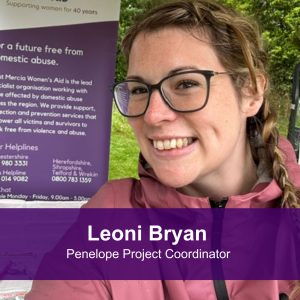
Project Coordinator, Leoni Bryan said:
“The funding has allowed us to prevent provide and promote domestic abuse provision in our areas using specialist knowledge and a person centre approach to the barriers this community face. Understanding military culture and terminology’s support victims to access trauma informed service within the Penelope Project preventing stressful and traumatising experiences in general DA service providers. The support we have had from the military community has been outstanding. Whether this is spouse completing ambassador training, the welfare teams supporting victims, military bases allowing access to local community centres and provision. Members of this community coming together with a common goal to support our most vulnerable is evident to see and promotes a legacy of support.”
From darkness to hope – voices from the beneficiaries
“I wouldn’t have gotten here without everyone’s support. So, I want to say thank you for listening, understanding, and supporting. I really do appreciate you. I feel like I’m starting to see the light at the top of a dark hole and begin a new chapter.”
“I didn’t even know the service existed where I could get this information and advice at the baby and tots’ group on camp. I feel so much more confident about my rights and parental responsibility. Leoni spoke to me making sure I was in control of where my information was stored and gave me respect and time to talk. I hope I can get back in touch in the future if I feel able to pursue family court, it will mean so much to have this support.”
“Compassionate, personal, kind from Leoni.”
“You have been there for me every step of the way. I am now safe, my children are safe, and I have my life back. I hope one day I can give back to someone else in my situation and would love to complete the ambassador training when the time is right”
Ruby’s Story
Ruby entered service through the Penelope Project after reaching out to her unit welfare team to ask for help as she was suffering from domestic abuse perpetrated by her husband. Ruby has a spousal visa and is married to a commonwealth soldier.
Ruby disclosed to the welfare team she had no money to buy food, and could they help her? The welfare team who had all recently undertaken domestic abuse ambassador training picked up elements of abuse within her comments on her marriage and asked for consent to refer her to the Penelope Project. Ruby consented.
Ruby met with worker Sarah. Sarah found a safe location to meet with Ruby face to face to talk about Ruby’s recent experiences. Ruby shared that she had just given birth to her third child in four years, that her husband like to keep her pregnant, but her third child had been born with slighter darker skin than her husband, and he had been causing arguments with her stating she had cheated on him, and the baby wasn’t his.
He had left her recovering from a C section on her own in an upstairs bedroom with no water or food, and she was having to complete the school runs with her injuries from birth to take her younger children to nursery. Ruby informed Sarah that her husband had refused to give her any money for food since the birth of her child, and he had pressurised her into ringing work to force her to go back to work within the next few weeks or she wouldn’t receive any further money from him.
Ruby stated she didn’t know how she would cope and who would look after her youngest, but he told her if she didn’t do this then he could get the army to evict her from the military accommodation. Ruby also stated how jealous and controlling her husband was. He had a door Cam and would monitor her and there would be consequences if she spoke to delivery drivers or was a few minutes late back from the school run.
Sarah worked with Ruby to explore options and support. She helped Ruby identify the abuse and controlling behaviour occurring in her marriage. Because Ruby had no access to public funds, Sarah offered realistic options regarding what could happen to Ruby’s visa status and explained which agencies could support her in seeking alternative routes to remain in the country if she chose to flee and leave her husband.
Financial support was also offered in the forms of food bank parcels, and household support funds. The welfare officers were also able to help with military charity applications to gain finances for petrol money and clothes for the children.
Eventually with support and safe planning, Ruby left her husband and took her children to safety residing in out of area refuge. Ruby received a new residency card whilst she is seeking indefinite right to remain under the domestic violence clause and has a support worker to support with long term actions such as tangible long-term housing, and therapeutic counselling support. The children are safe, settled, and happy. Ruby is starting her new life, and in her own words, feels free from her husband and no longer feels worthless and trapped.
Violet’s story
Violet is a female soldier serving in the army. Her friend Tazmin had recently completed the domestic abuse ambassador training which was offered to female soldiers in their local barracks. Tazmin encouraged Violet to attend a drop-in clinic hosted by the Penelope Project due to recent incidents of stalking and harassment she was experiencing.
Violet attended the drop-in clinic very nervous about where her information was going and where it would be stored. Sarah, the Penelope Project worker, reassured Violent and explained we are a non-statutory charity and here to offer confidential domestic abuse information and support.
Violet explained she felt worried approaching the welfare team in case she was viewed as a ‘welfare case’ or ‘a troublemaker’. She had just broken up with her boyfriend who was also a serving soldier in the same squadron as her. She had broken up with him because he had become increasingly controlling and jealous, and it had become too much for her.
When she broke up with him, he had been verbally aggressive, and the following nights had tried to break into her room on barracks by kicking the door and she had caught him spying through her window. Violet had felt scared, and embarrassed and didn’t know what to do.
Domestic abuse support was offered to Violet in the form of a person-centred safety and support plan. We talked through options for increasing her safety, including digital and online safety planning, as well as an action plan outlining what to do if the physical abuse were to escalate in person.

Due to the funding of the safety device boxes, Violet was able to borrow a dashcam to put on her car to make sure when she was travelling, he was not following her. She also took a door wedge alarm so if he tried to enter her room whilst she was sleeping an alarm would sound. We discussed lots of other options including accessing our online freedom programme. Violet was able to access our support confidentiality with no fear or institutional repercussions. Violet was able to consider her choices at a pace that felt safe for her and continues to work with our support worker longer term.
Find out more
Read more about other Free from Fear projects we’ve supported
Read more about the Penelope Project here